Research Spotlight: Experiencing Data Through the Body
An Interview with Professor Hiroo Iwata, Faculty of Data Science, Musashino University
This interview was conducted with Professor Hiroo Iwata, a collaborator of Mohamed Soliman (AAII Researcher), in conjunction with the upcoming exhibition "Walk-Through Experience of Qaitbay Citadel: The Legendary Alexandria," hosted by the Asia AI Institute (AAII) at Musashino University on December 2–3, 2025. For event details, please see the Event Information section below.

Figure 1. Professor Hiroo Iwata, Faculty of Data Science, Musashino University
As part of a series introducing research at the Asia AI Institute (AAII) and Musashino University's Faculty of Data Science (MUDS), Associate Professor Yusuke Takahashi interviewed Professor Hiroo Iwata. Professor Iwata is a world-renowned authority in virtual reality (VR), haptics (force and tactile feedback technology), and locomotion interfaces. He previously served as President of the Virtual Reality Society of Japan. Currently, he leads the "Data Sensorium" project, which bridges cyberspace and physical space, exploring the importance of bodily sensation in data science.
Takahashi: Professor Iwata, thank you for taking the time to speak with us today. Could you start by telling us about your background and what led you to join the Faculty of Data Science?
Iwata: Thank you. I studied mechanical engineering at the University of Tokyo and received my Doctor of Engineering degree in 1986. After that, I continued virtual reality research at the University of Tsukuba for over 35 years. From 2016 to 2020, I also served as President of the Virtual Reality Society of Japan. I joined Musashino University in April 2023 because I wanted to bring a new perspective of "bodily sensation" to the field of data science. Current data science tends to focus on viewing numbers and graphs on screens, but humans are inherently beings who understand the world through their five senses. I believe that enabling people to physically feel information from cyberspace will open new horizons in data comprehension.
Takahashi: You are world-renowned in the VR field. Could you tell us about your research so far? I'm particularly interested in your achievements at SIGGRAPH and Ars Electronica.
Iwata: The core of my research lies in the question: "How can we recreate human bodily sensations in virtual space?" There are broadly two areas. One is "haptic interfaces," technology that recreates the tactile feedback when touching virtual objects. The other is "locomotion interfaces"—devices that create the sensation of walking around virtual space with your own feet while actually remaining in place. A representative example is the "Torus Treadmill," which realized an infinite floor surface that allows walking in any direction. These achievements were presented every year at SIGGRAPH's Emerging Technologies venue from 1994 to 2007, and I received honorary mentions at Ars Electronica in 1996 and 2001. In 2011, I was also honored with the Minister of Education, Culture, Sports, Science and Technology Award for Science and Technology.
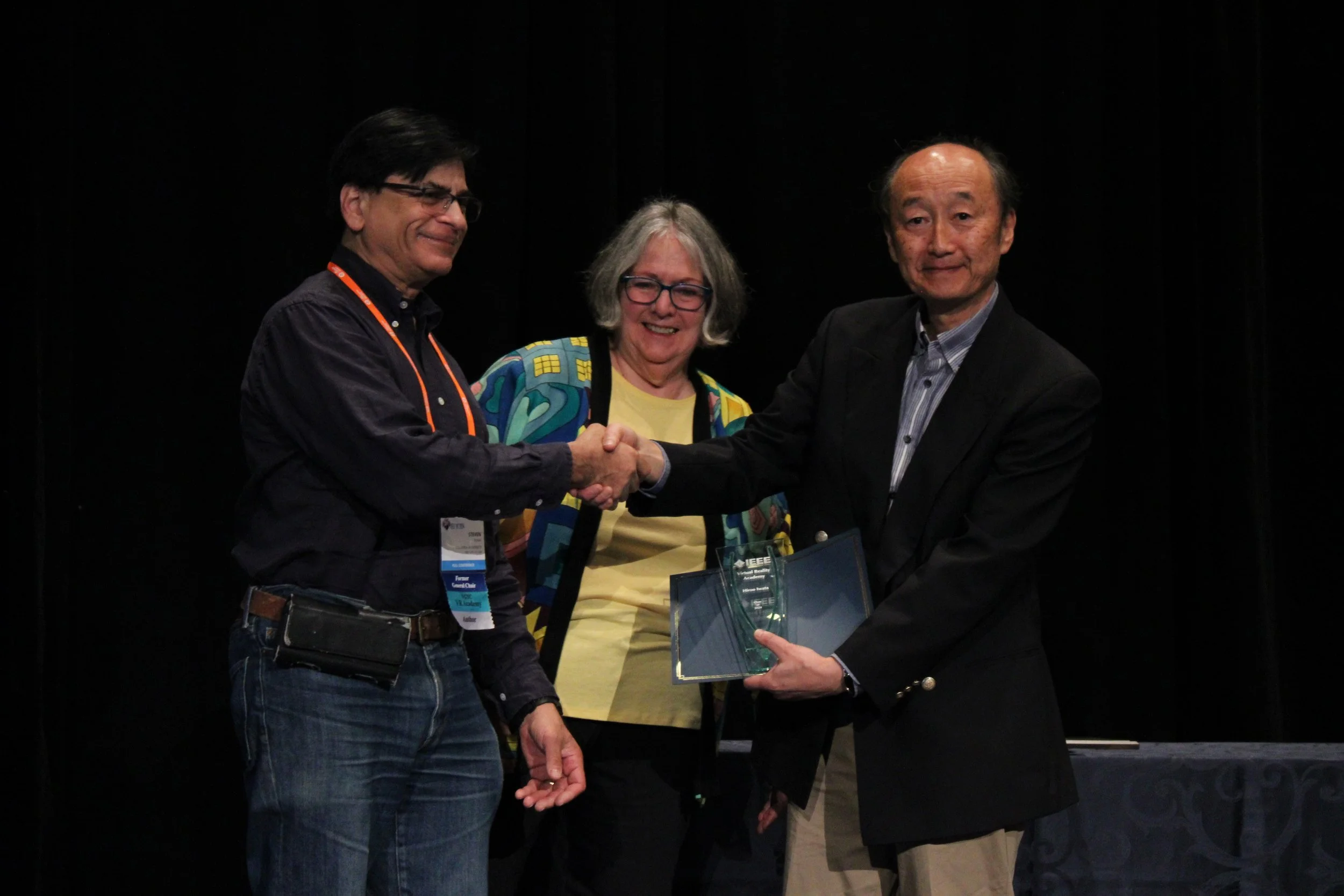
Figure 2. Scene from the IEEE VR award ceremony.
Takahashi: I understand you also proposed the concept of "Device Art." What exactly is that?
Iwata: Device Art is a new form of expression where the device itself becomes the artwork, utilizing mechatronics and materials technology. Traditional art places content on media such as paper or canvas. However, in Device Art, the device that people interact with becomes the expressive content itself. In fact, Japanese traditional cultures such as tea ceremony and flower arrangement, which emphasize interaction with tools and space, can be seen as roots of Device Art. As a CREST research project funded by the Japan Science and Technology Agency (JST), I collaborated with many artists including Maywa Denki and Kazuhiko Hachiya.
Takahashi: Could you tell us more about the "Data Sensorium" project you are currently leading at Musashino University?
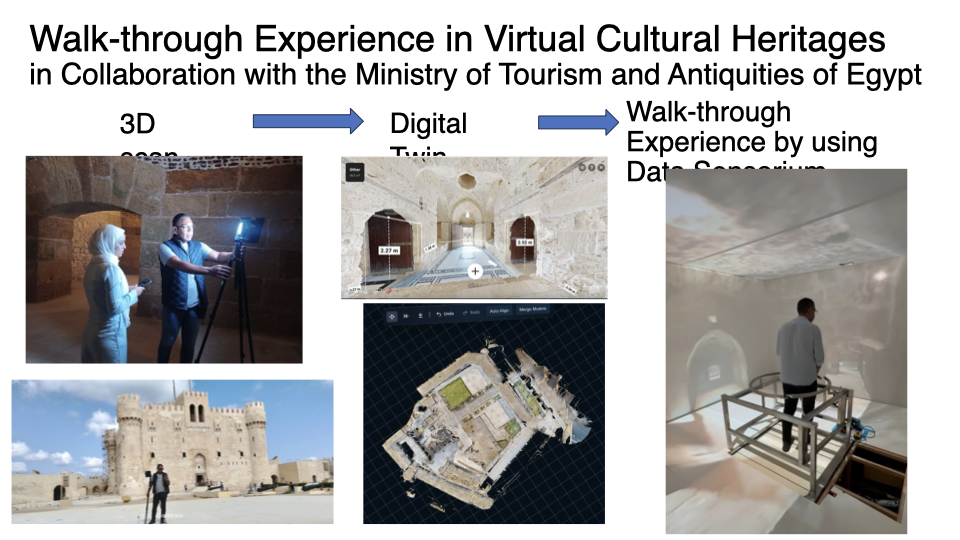
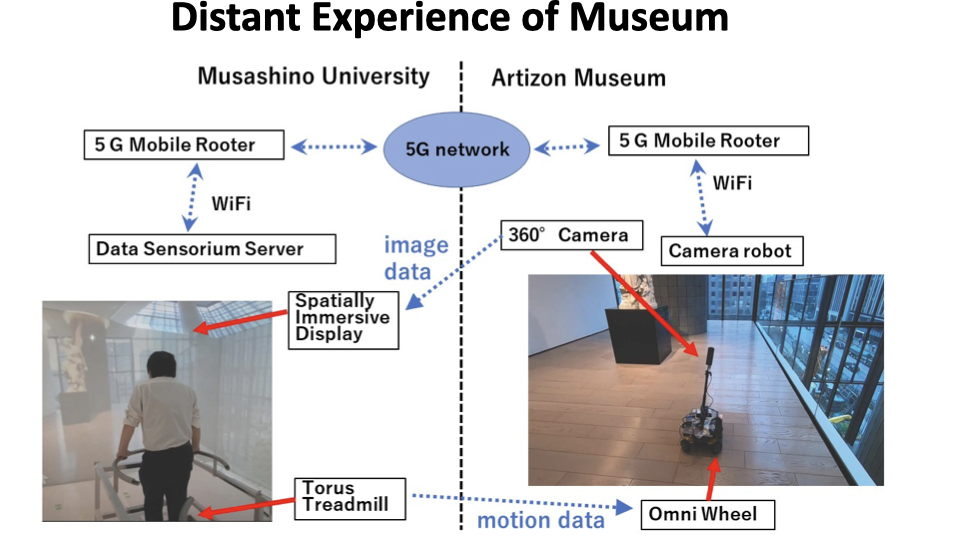
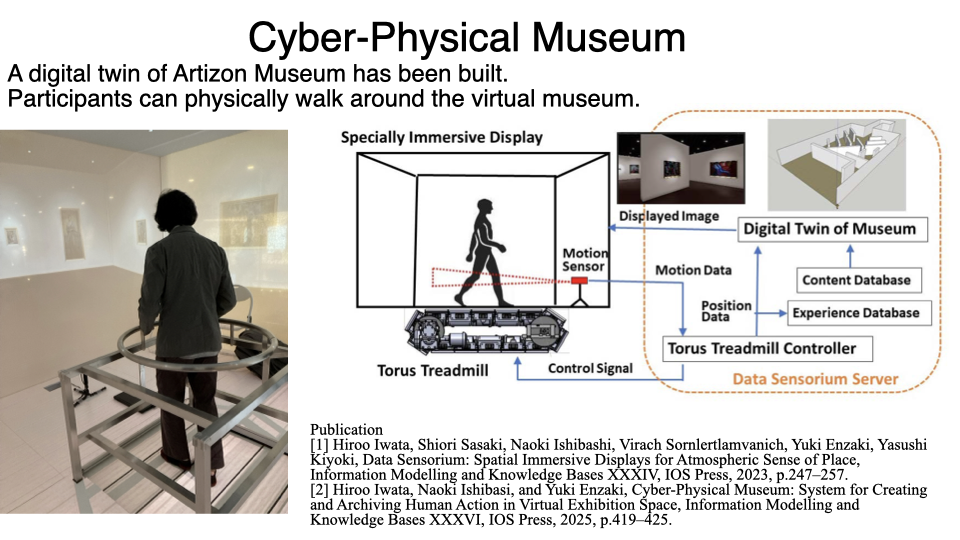
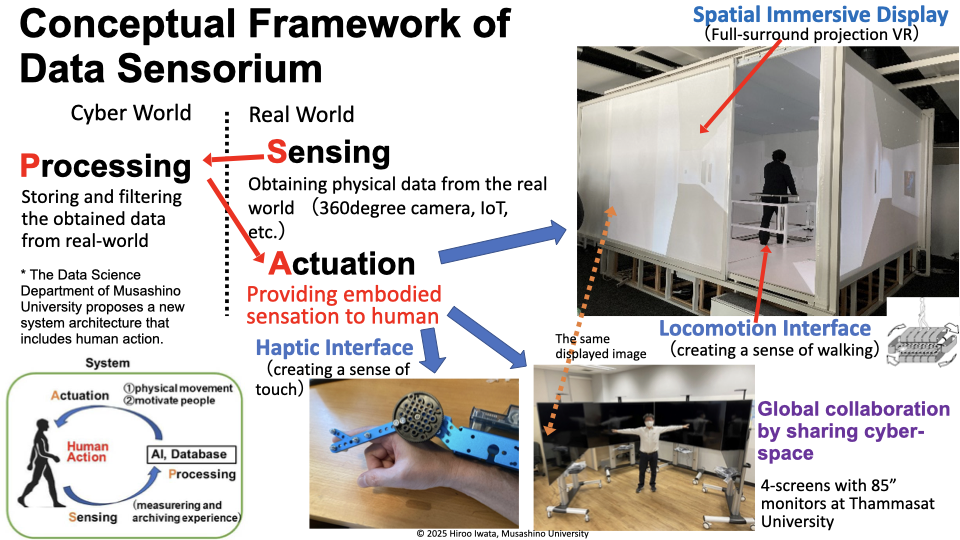
Iwata: Data Sensorium is a system that delivers information from cyberspace or remote physical spaces as human bodily sensations. By combining spatially immersive displays, locomotion interfaces, and haptic interfaces, it enables people to "experience with their own bodies" distant locations and digital spaces. As a concrete application, we developed a "Cyber-Physical Museum" by creating a digital twin of the Artizon Museum, providing an experience essentially equivalent to walking through and appreciating the actual museum with your own feet. Additionally, through joint research with Egypt's Ministry of Tourism and Antiquities, we have realized virtual walking experiences of ancient heritage sites. The Asia AI Institute proposes a new philosophy of "incorporating human activity into system architecture," and Data Sensorium is precisely the embodiment of this vision.
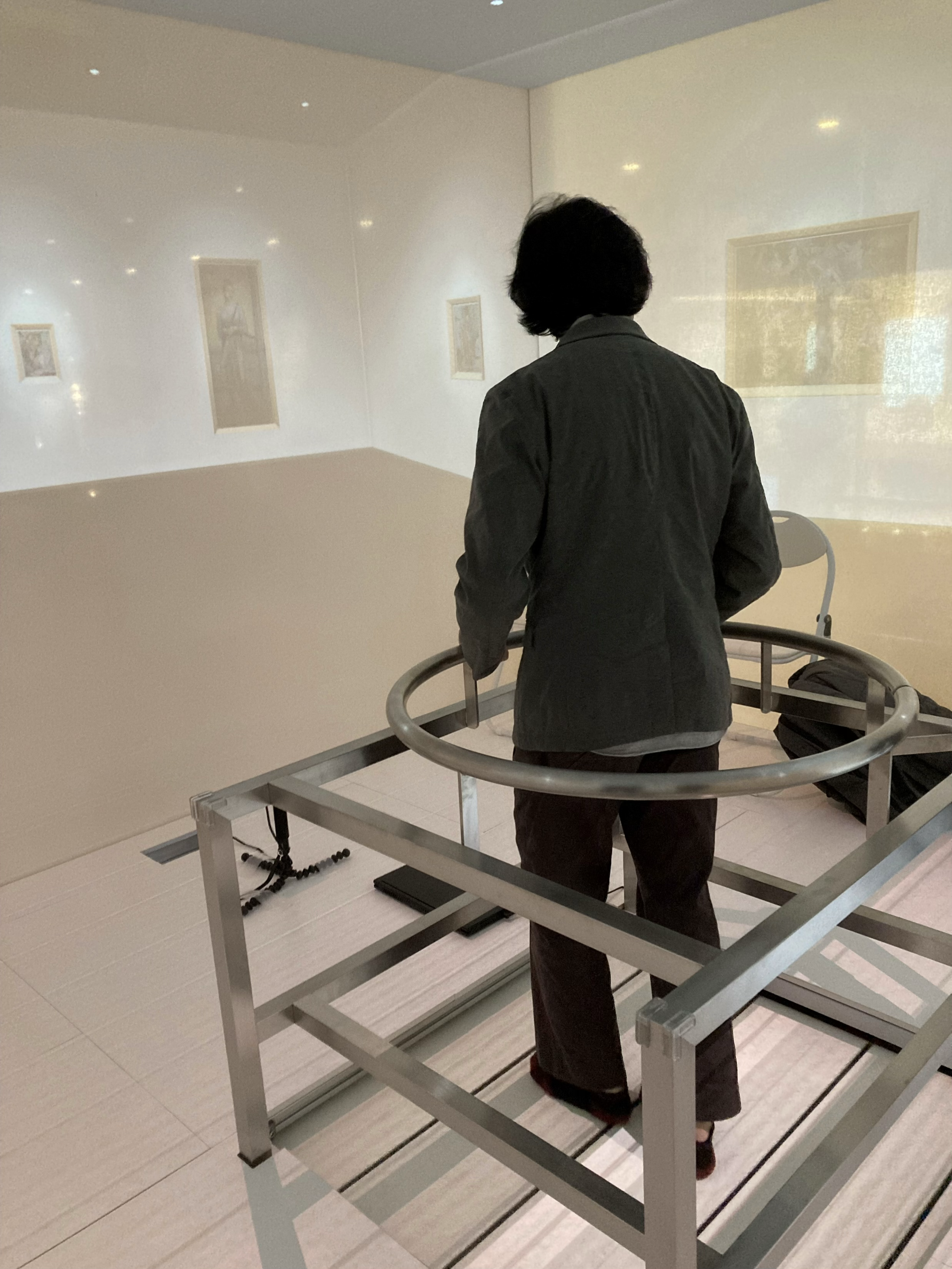
Figure 3. Data Sensorium is a system that provides information from cyberspace and remote physical spaces as human embodied sensations. It is intended to serve as a collaborative research platform that spans various projects at the Asia AI Institute internationally.
Takahashi: How about international collaboration? Could you also tell us about the connection with the Musashino International Data Science (MIDS) program scheduled to open in 2026?
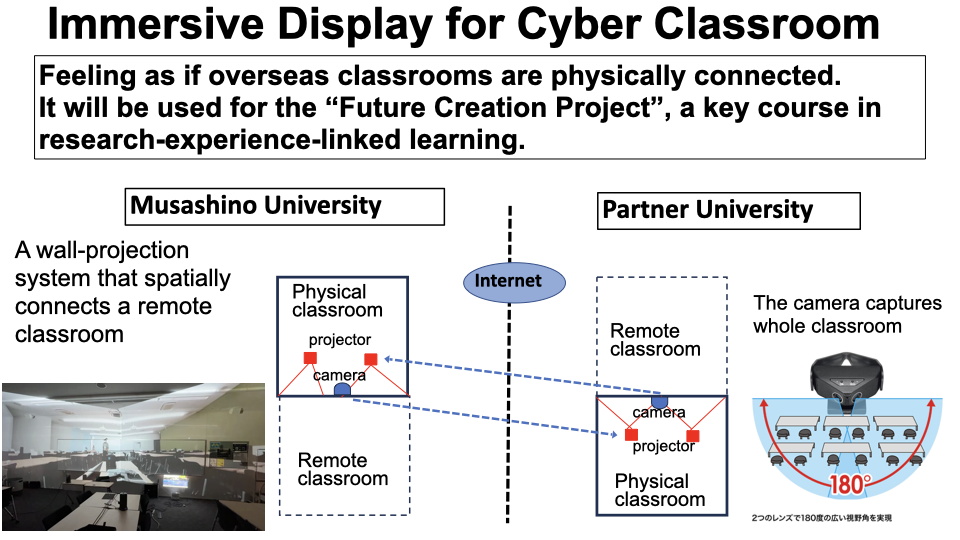
Iwata: One of the major features of Data Sensorium is that it serves as a platform for international collaborative research through shared cyberspace. For example, we have installed a four-sided display at Thammasat University in Thailand, providing an experience as if it were spatially continuous with our laboratory at Musashino University. In what we call the "Telepresence Cyber Classroom," overseas classrooms feel as if they are spatially connected to Musashino University's classrooms. With MIDS, we aim to utilize these technologies to create an environment where students and researchers from around the world can learn and conduct research together in the same virtual space. I am convinced that "shared physical experience" transcending physical distance will create new forms of international education.
Takahashi: Finally, do you have a message for students interested in data science and VR?
Iwata: When people think of data science, skills that involve "thinking with your head" such as programming and statistics tend to be emphasized. However, at the end of data, there are always "humans." Deeply understanding how humans perceive and experience the world leads to truly valuable data utilization. VR and haptics technologies are gateways to such human understanding. I also want students to value the fusion of art and technology. New technology creates new expression, and new expression evolves technology. This cycle is the wellspring of innovation. Please embrace your curiosity and challenge research that breaks free from conventional frameworks.
Takahashi: Professor Iwata, thank you for sharing these valuable insights. Your research plays an extremely important role in adding a new dimension of bodily sensation to data science and advancing international research collaboration at MUDS and AAII.
Iwata: Thank you as well. The possibilities of data science are limitless. I hope to spark new waves of research from Musashino University to the world.
Professor Hiroo Iwata - Profile
Professor and Department Chair, Faculty of Data Science, Musashino University. Completed doctoral program at the University of Tokyo Graduate School of Engineering in 1986 (Doctor of Engineering). After serving as Professor at the University of Tsukuba's Faculty of Engineering, Information and Systems, he assumed his current position in April 2023. His specialties include virtual reality, haptics, and locomotion interfaces. He served as President of the Virtual Reality Society of Japan from 2016 to 2020 and currently serves as Special Advisor. Received the Minister of Education, Culture, Sports, Science and Technology Award for Science and Technology in 2011. Exhibited annually at SIGGRAPH Emerging Technologies from 1994 to 2007. Honorary mentions at Ars Electronica (1996, 2001). Publications include "VR Practical Course: Four Key Technologies Beyond HMD" (Science Information Publishing, 2017).
Event Information
Exhibition Announcement
Walk-Through Experience of Qaitbay Citadel: The Legendary Alexandria
The Asia AI Institute (AAII) at Musashino University is pleased to announce the following exhibition.
Event Details:
Dates: December 2–3, 2025
Time: 09:30 – 15:00 (both days)
Venue: Asia AI Institute (AAII), Musashino University
About the Exhibition:
Using advanced Data Sensorium technology, visitors can enjoy a walk-through experience of the legendary Qaitbay Citadel in Alexandria. This exhibition offers a unique opportunity to experience one of Egypt's most iconic historical monuments through cutting-edge technology.
Exhibitor:
Mohamed Soliman (AAII Researcher)
This event is by invitation only. If you have any questions or inquiries, please feel free to contact us.
We look forward to your participation.
For more information about research collaboration at MUDS and AAII, please contact us at muds.ac/contact.