
Two Years of Awards. Four Years In — The Full-Stack AI Engineer Designing AI That Actually Works on the Ground
Series: Changing the World With Data. — MUDS Alumni Spotlight / Stories from Musashino University Faculty of Data Science
Just four years into his career, Rintaro Nakahodo has already won Microsoft Japan's “Microsoft Top Partner Engineer Award” two years in a row, in 2024 and 2025 — and he is now leading multiple large-scale AI agent projects for major Japanese manufacturers. As an FDE (Field Digital Engineer) at Fujitsu Limited, and a 1st-cohort alumnus of Musashino University's Faculty of Data Science (MUDS), Rintaro brings cutting-edge AI down from the lab and into the shape it needs to actually work on the ground. We sat down with him to talk about his work today, what MUDS taught him, and his message to the next generation of engineers.
Rintaro Nakahodo — MUDS 1st-Cohort Alumnus (FDE Engineer, FDE Division, Fujitsu Limited)
Interviewer: Prof. Nakamura (Faculty of Data Science, Musashino University)
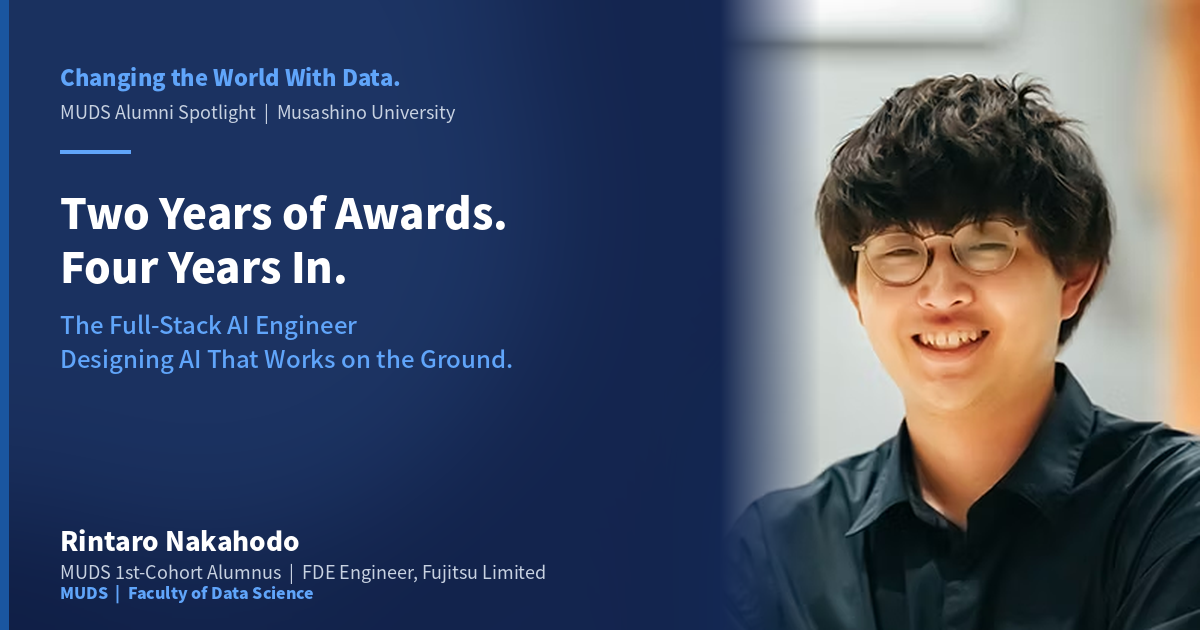
Rintaro Nakahodo — MUDS 1st-Cohort Alumnus (FDE Engineer, FDE Division, Fujitsu Limited)
The FDE Role — Designing AI That Actually Works on the Ground
Prof. Nakamura: Rintaro, let's start with what you're doing today.
Nakahodo: I work at Fujitsu's FDE Division as an FDE (Field Digital Engineer), and my mission is to bring AI agents and generative AI into real-world implementation in society. Put simply, my job is to take cutting-edge AI technology and turn it into something that actually works on the ground. Rather than stopping at PoC (proof of concept), I face real business challenges head-on and design and build systems where AI supports and accelerates the work people do.
More concretely, I work alongside clients in major manufacturing and the automotive industry to develop AI solutions that directly fix problems on the ground — improving inefficient workflows, automating repetitive tasks, and redesigning entire business processes. I often take on the role of architect — the person responsible for the overall design — covering everything from technology selection and system design to proposing solutions to the client.
Prof. Nakamura: What kind of engineer is an FDE?
Nakahodo: An FDE is an engineer who goes directly into the client's site, takes the time to deeply understand the real problems, proposes a solution that creates value, and moves the business forward with speed — it's a new kind of role, I think.
Onto “Kozuchi” From Day One — Learning How to Deliver Tech to Society
Prof. Nakamura: I heard you were involved from very early on with the launch of Fujitsu's generative AI platform.
Nakahodo: Yes. Right after I joined, I had the chance to take part in the launch of Fujitsu's generative AI platform, “Kozuchi Generative Conversational AI.” I was given the role of leading the collaboration with partner companies who bring cutting-edge technology, and — as a young engineer — I got to work on the project of delivering each partner's latest generative AI technology to our customers as quickly as possible.
That experience gave me a perspective I've kept ever since: it's not just about building the technology, it's about how you actually deliver it to society. That was something I worked on thoroughly during that period.
Prof. Nakamura: And after that, you've been bringing AI agents into companies across many industries.
Nakahodo: Yes. I've worked on multiple projects deploying AI agents into the actual day-to-day operations of customers across several industries. Not just making the technology run, but accompanying the customer all the way through — until the technology takes root and starts producing value. That stance is what eventually led me to my current position as an FDE.
What Won Him Two Awards — Problem Analysis and Practical Problem-Solving
Prof. Nakamura: You won the Microsoft Top Partner Engineer Award two years in a row, in 2024 and 2025. What do you think they recognized?
Nakahodo: What I understand is that they valued the “ability to analyze problems” and the “practical problem-solving” required to actually apply generative AI to real business situations. To receive an award that recognizes top engineers leveraging Microsoft's advanced technologies — two years in a row, only four years into my career — is genuinely an honor.
Prof. Nakamura: Where do you feel your own strength comes from?
Nakahodo: Moving on my own initiative — I think that's really the heart of it. Whether I'm at the client's site or inside the company, I keep proposing and acting beyond the walls of organizations and seniority. When I feel “I want to do this” or “I can solve that,” I bring my ideas forward without worrying about position or title, and I go grab the opportunity myself. That kind of proactive stance, I believe, is what's led to me being trusted as the architect of large projects so early in my career.
Prof. Nakamura: Fujitsu has a full flex-time system. What does your actual working style look like?
Nakahodo: It's true that the environment is flexible. But for me personally, it feels less like “leaning on the system” and more like simply throwing myself at the work with everything I have. Raising quality while still putting in the volume — that steady, honest accumulation is what's become the foundation of whatever skill I have today.
How MUDS Built the Foundation I Stand On Today
Prof. Nakamura: How does what you learned at MUDS show up in your work today?
Nakahodo: What MUDS emphasized wasn't theory in isolation, but the practical skill of actually running systems on real data. That “implementation muscle” and “data-analysis ability” are exactly the foundation that lets me lead cutting-edge projects today.
Prof. Nakamura: What was the learning environment like, from your perspective?
Nakahodo: Even while I was a student, I had this strong drive — that I wanted to use AI to change society and people's lives for the better. The faculty stood very close to the students, and they backed up that passion with everything they had so we could actually turn it into something real. That, more than anything, was MUDS's greatest strength.
Off the Clock — Sandlot Baseball, Game Dev, Stars and Whisky
Prof. Nakamura: Beyond work, tell us a bit about how you spend your time.
Nakahodo: I started a sandlot baseball team with colleagues from my year at work, and we play on weekends (laughs). I also still do game development — something I started as a student — as a side project, because I want to keep widening my range as an engineer.
Off-hours, I enjoy stargazing, hopping between hot springs, and reading technical books with a glass of sherry-cask whisky in hand. I think I'm the type who tries to enjoy both work and life as fully as possible.
To Future Engineers — Keep Asking “What Do I Want to Change?”
Prof. Nakamura: Finally, please share a message for high schoolers considering MUDS / MIDS, and for working professionals thinking about learning again.
Nakahodo: What does it mean to “live as an engineer”? What I feel strongly right now is that technology is, at the end of the day, just a tool — and what really matters is to keep asking the question, “What in the world do I want to change?”
In the age of generative AI, using models like OpenAI's or Claude, and building your own cloud infrastructure on AWS, Azure, or GCP, are no longer particularly special skills. What's being asked of us is what you build with that technology — what kind of problem in society you choose to face.
The hints are surprisingly close at hand. A small inconvenience in daily life, a casual conversation with a friend, an inefficient system you spot on the street. Look at them with eyes that say, “Maybe I could change this.” The functions and systems that change the world are often born exactly from there.
It's okay to write a paper. It's okay to just run an experiment. Above all, what makes you real is continuing to put something — anything — out into the world. Your professors are the pros. Don't hold back; bring your work to them. The experience of having your work reviewed will, without fail, become real strength.
And more than anything else — please throw your thoughts and convictions at your friends. About technology, about society, even about silly ideas. Friends who share the passion of “I want to build something good” become the greatest asset you carry, even after you leave school.
There's a kind of time and freedom that only exists during student life. In that time, build a lot, fail a lot, and learn a lot. That accumulation, I'm convinced, becomes the real foundation of an engineer who can survive the generative-AI era.
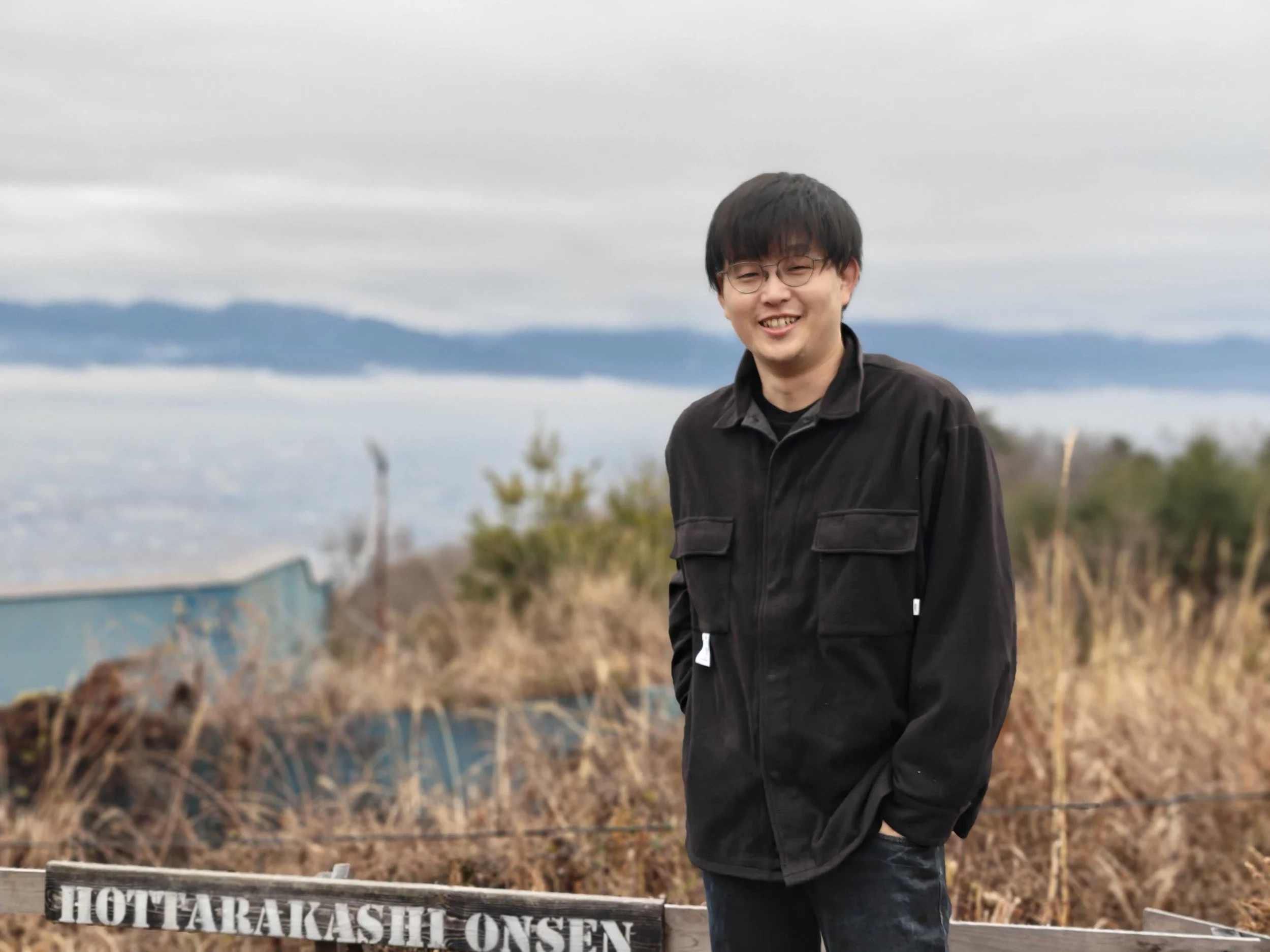
Rintaro Nakahodo — MUDS 1st-Cohort Alumnus (FDE Engineer, FDE Division, Fujitsu Limited)
Profile
| Name | Rintaro Nakahodo |
| Career | FDE Engineer, FDE Division, Fujitsu Limited (4th year) |
| Highlights | Two-time consecutive recipient of Microsoft Japan’s “Microsoft Top Partner Engineer Award” (2024 and 2025). Leads multiple large-scale AI agent projects for major Japanese manufacturers. |
| Off-Hours | Started a sandlot baseball team with colleagues from his year. Continues game development — begun in his student days — as a side project. Enjoys stargazing, hot-spring trips, and reading technical books with a glass of sherry-cask whisky. |
| Alma Mater | Faculty of Data Science, Musashino University (MUDS) — 1st cohort |
Join Us at MUDS / MIDS — We're Looking for New Companions
We support every challenger who, like Rintaro, wants to use data science to change the world. Musashino University's Faculty of Data Science (MUDS) and the International Faculty of Data Science (MIDS, Distance Learning Division, opening April 2026) offer five learning pathways designed for students from a wide variety of backgrounds — high school students, students enrolled at our overseas partner universities, university graduates, and working professionals.
MIDS — Five Learning Pathways
Pathway 1: 5-Year Integrated Program (for high school students and new entrants)
Pathway 2: Double Degree starting in Year 3 (for students at overseas partner universities)
Pathway 3: Double Degree starting in Year 4 (for students at overseas partner universities)
Pathway 4: Double Degree + 1-Year Master's (for students at overseas partner universities)
Pathway 5: 2-Year Track for University Graduates and Working Professionals
▶ Details for each pathway: https://web.ds.musashino-u.ac.jp/blog/20251224-5-pathways-to-mids-en
[Important] If You Aim to Complete the Master's Program in 1 Year
To complete the graduate master's program in one year, you must apply for the 5-Year Integrated Program (or equivalent) during the enrollment-preparation period after acceptance is announced. In addition, a separate application (with a fee) and entrance examination for the master's program will also be required. For details, please refer to the admissions guide or contact the Admissions Office.
Contact
Musashino University Asia AI Institute
3-3-3 Ariake, Koto-ku, Tokyo 135-8181 — Musashino University Ariake Campus
Yusuke Takahashi, PhD — Associate Professor
Email: yusuke@ds.musashino-u.ac.jp
Related Resources
Musashino University 5-Year Integrated Program: https://www.musashino-u.ac.jp/basic/fiveyear/index.html
Apply (MIDS / Distance Learning Division): https://www.musashino-u.ac.jp/academics/faculty/international_data_science/
